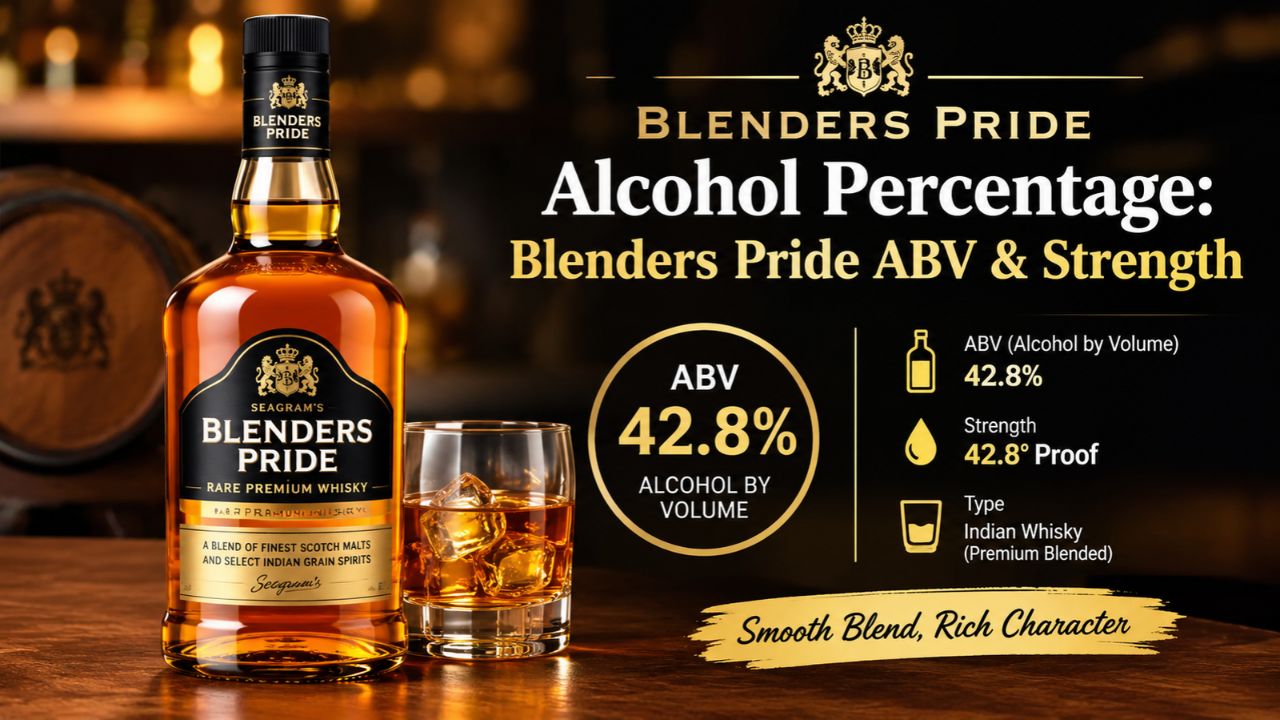
WritBlenders Pride Rare Premium is the stronger of the two expressions we've spoken about here at 42.8% (compared to Blenders Pride, which is listed at 40%). Pernod Ricard describes the product as a whisky with Indian grain spirit and Scotch malts, placing it firmly in the premium Indian whisky set. Tech details in which they talk about "aromatic, woody, fruity and slightly peated" attributes. So, when we talk about the percentage of alcohol in a blend, we should refer to the 42.8% strictly as the Rare Premium expression rather than blanket apply it onto the entire brand.
Blenders Pride Reserve Collection Alcohol By Volume
It has a stated ABV of 40% and is the Blenders Pride Reserve Collection. Applied as one might expect should result in a whisky of lower than 42.8% ABV (as Rare Premium), but either is still high alcohol whiskies by many beer or ready to drink beverage standards, though. Reserve Collection is touted as a premium offering from the label and claims to be a blend of scotch malts with Indian grain spirit. Knowing the difference is key to obtaining current and accurate information on blender alcohol percentages (40% vs 42.8%). Beyond the whisky prices and alcohol content, those looking for liquor updates may check Madira Deals making it a useful medium providing reliable liquor-related news.
Why Blender Alcohol Content Matters
This allows those consumers to understand how much alcohol is in the whisky that is actually very important information given that different types of whiskies provide a different amount of alcohol. The blender alcohol percentage tells us the strength of only the whisky they are reviewing. Bob: ABV does Would you want to know whether some Whisky is good or bad,abv gives you some idea about strength. It can also assist individuals in comparing different alcohols more effectively. A higher ABV whisky has a lower alcohol by volume ratio and not vice versa. That said, the amount used in total is also dependent on size, meaning ABV alone should never be looked at without volume taken into consideration.
How Is ABV Calculated In Whisky?
ABV or Alcohol by Volume: The amount of pure ethanol in relation to the total volume of all liquids in the beverage. To give you an idea, remember that a whisky can be 40% ABV [alcohol by volume], therefore if you have a 100 ml of whisky making it to the mouth, it is somehow equal to around 40 ml pure alcohol. Hence, 100 ml of a whisky that is 42.8% ABV contains approximately 42.8 ml of absolute alcohol per volume. Using this simple calculation allows for an understanding of blender alcohol and it helps consumers to understand why normally the concentration of whisky is higher than most other widely involved alcoholic beverages.
How Much Alcohol Is In 100 ml Blenders Pride
Alcohol content varies from version to version of Blenders Pride and for each 100 ml this comes to. With 42.8% ABV, 100 ml of Rare Premium equals around 42.8 ml pure ethanol per 100 ml of solution, and if you stick to a maximum consumption for a man to keep the blood alcohol level at or below technical driver safety standards — it resembles about ten torturing shots in the column. How malty is the peak full-bodied beer with straw as pure as wheat? With a 40% ABV, one 100 ml glass of Reserve Collection is equal to about 40 mls of pure ethanol by volume. These numbers may help you understand why there is a difference in the alcohol content of a blender, but they should not be taken as serving recommendations. Consumers should adhere to relevant laws and guidance on responsible consumption by drinking-age consumers.
How Much Alcohol Is In A 750 ml Bottle
A 750 ml bottle has a fair bit of whisky in it, thus its total alcohol volume can be approximated through the products ABV as determined on a per hundreds cubes basis. To put this into perspective, a 750 ml bottle at 42.8% ABV is essentially about 321 ml of pure ethanol by volume and a 750 ml at the usual 40% ABV contained only around 300 ml. Such calculations explain why in terms of total alcohol per bottle, both the size of a bottle and the percentage of alcohol in a blender matter.
Does Blender Alcohol Percentage Change with Bottle Size
Size of the bottle one thing, concentration on alcohol another. When multiple bottle sizes are available for the same Blenders Pride expression, the ABV is typically unchanged from what it was for that expression. A smaller bottle is just less total liquid and therefore less total alcohol. For instance, 40 percent ABV is the same whether it's a bottle of something that amounts to 180 ml or a decanter containing 750 ml (again, assuming we're talking about the same product spec). The stated alcohol percentage in the blender is not how bottle size changes; it is instead the quantity of a certain blend.
Beer vs Blender Alcohol Percentages
This ultrasound comparing the blender alcohol percent to beer is a perfect przykład of why in barbie comparison our entries need along with serve bulk. There are vast differences in the strength of beer from product to product, but many beers have far lower ABVs (alcohol by volume) than whisky. Consequently, the same flavours packed into 40%, or 42.8% ABV Blenders Pride could be a lot higher on volume. Having noted that, if we measure only by ABV we'd have a skewed result — because people typically drink different amounts of beer and whisky. Remember, comparing how much alcohol content you drank requires looking at both the strength of each beverage and the size of your serving.
Blender Alcohol Percentage Evaluation Among Other Whiskeys
Blenders Pride alcohol percentage for the blend is in a space you already know in whisky. However, the average bottle of whisky is about 40% ABV with some expressions bottled at cask strength (Higher Strength). Although not common this rare Premium has 42.8% ABV but Blenders Pride Reserve Collection goes for normal whisky bottling strength of approximately 40% ABV, thus bringing its price into line. All that means is a change in ABV; quality alone does not directly follow this as whisky character also depends on blending, ingredients and maturation.
The Effect of Alcohol Percentage on the Taste of Whisky
When whisky is served neat, alcohol concentration can affect how it feels in the mouth and to some extent its taste. In comparison with a lower ABV, an increased one can yield a greater warming effect and change the way aromas and flavors are perceived as well. That being said, variables of the blender alcohol percentage are only one parameter in the profile of a whisky. Grain spirit, malt components, maturation and blending techniques, water and serving temperature all play a role in the final character. Two whiskies can have the exact same ABV and taste vastly different from one another in terms of aroma, flavor, or finish.
Adding Alcohol Open up deep and Lets try because December blender alcohol percentage halloween party with out a doubt
We might note that U your mouth is a good diluted whisky in the glass, I didn't change the original ABV skinny on the bottle but it added H2Arm to the college. So adding water to, say a 42.8% ABV whisky dilutes the concentration of alcohol in the mixture (now between both spirits). This unopened item is a 42.8% ABV whisky. Whisky drinkers sometimes use water because it can alter scent, mouthfeel and perceived strength. The final alcohol percentage in the beverage is determined with the volume of water added.
The Effect Of Ice On The Alcohol Percentage
As ice melts, the water will also further dilute whisky resulting in a lower alcohol concentration. At the beginning of adding an ice cube, you do not increase the alcohol content of whisky labelled in a bottle in a blender. The ice melts, and the water becomes integrated with the whisky, and as such dilutes its alcohol content in the glass. Ice can change temperature, and therefore how aromas and flavors are experienced. Even though the drink served can be diluted to some degree, the original ABV remains as a static product specification.
Is this 42.8% ABV a Powerful Whisky
An ABV of 42.8% is well within the range seen in many whiskies and so not an uncommon strength for the category — certainly something that can be done in a very small still! It has a slightly higher alcohol content, then a whisky bottled at 40% ABV, but the difference is relatively small. How burning it tastes will depend on the drinker, how it is served, and if the whisky is drunk neat or diluted. So you ought to think of the percentage of alcohol in a blender as an indicator of concentration rather than a direct indicator of how easy or strong you will actually feel once downing any whisky.
Blenders Pride Reserve Collection Ducktape Blenders Pride Reserve Collection Weaker than rare - Premium
Specifically, according to the stated ABVs, Reserve Collection has less alcohol than Rare Premium with a listed 40% ABV compared to 42.8%. But to describe one product as superior or inferior solely by alcohol percentage would be disingenuous. Their own entry in each of the following listings, such 1-Excerpt and Flavor Entries. Reserve Collection is described by the maker as a mix of Scotch malts and Indian grain spirit featuring an improved fruity palate, whereas Rare Premium has its own product profile.
Does a Higher Percentage of Alcohol Involving Blending/Blended Whisky, Make Better Whisky?
A higher percentage of alcohol in a blender is not synonymous with better quality whisky. ABV mainly informs consumers about the volume of alcohol concentration. There are many factors other than age, including the blend itself, maturation, aroma and flavor balance, opening/finishing notes for both nose and palate as well as personal preferences. To some consumers, a 40% ABV whisky is fine, yet others may have strong opinions towards fortified-reduced spirits and would much rather prefer an expression with slightly higher strength. So we should regard ABV, which is one specification among many, as not a ranking of quality.
Key Particulars about Blender Alcohol Proportion
So the most critical aspect of the blender alcohol percent is that it varies across Blenders Pride expressions. Nov 4, Rare Premium and Reserve Collection are two products that feature the condition with different official ABV specifications. This, therefore, signals to consumers that they should not take one number as reflective of the entire brand. The easiest method to obtain accurate information is to check the specific product name and bottle label.
The key points are:
Blenders Pride Rare Premium 42.8% ABV
Blenders Pride Reserve Collection comes with an alcohol content of 40% ABV.
ABV means Alcohol by Volume.
In short, the size of their containers affects the total quantity of alcohol and not its concentration.
Ice melting or the addition of water can make the served drink lighter.
Check the bottle label for relevant product specifications.
Verify the Proper Grapes Blender Alcohol Content
The simplest way to check what the alcohol percentage is in a blender is to find the actual product variant and look at the ABV listed on its label. This is especially important as Blenders Pride has more than a single expression. Well, official manufacturer info can be nice confirming evidence too. Older sites should be approached with caution when it comes to consumers, as product specs and packaging or regional availability can change. When accuracy matters, the current manufacturer's info and actual bottle label is better than an old third-party article.
Blend Percentage and Drinking Responsibly
While the blender alcohol percentage can give consumers a greater understanding of their drink, responsible consumption means considering how much was consumed as well. Whisky is much higher in alcohol by volume (ABV) than a lot of commonly drunk drinks and this means that even a small shot will contain a high amount of alcohol. Individuals have to comply with the legal drinking age and alcohol laws of their area. Abstract Any product with an ABV higher than 0% should not be consumed by any person who plans to drive or operate machinery.
Summary: Blender Alcohol Percentage
The alcohol percentage of blender also depends on what Blenders Pride expression we are talking about. Current official product specs for Blenders Pride Rare Premium indicates 42.8% ABV and Blenders Pride Reserve Collection at 40% ABV. Which also highlights why using one universal alcohol % is not a great practice across the portfolio. The simplest way to check the model itself is to validate the information you share in variant.
While ABV serves as an useful metric of alcohol strength, it does not by itself define the quality, flavor or style of a whisky. It also says nothing about the bottle size, how many you have in a serving and if you dilute it or not — that can make all the difference after October 2023, when your body will be as capable of consuming alcohol as any other! To go for the best, consumers should double check the manufacturer's updated product details along with ABV printed on bottles before relying on a specific blender alcohol percentage.
FAQs:
1. What is the blender alcohol percentage?
The blender alcohol percentage depends on the Blenders Pride variant. Rare Premium is listed at 42.8% ABV, while Reserve Collection is listed at 40% ABV.
2. Is Blenders Pride 42.8% alcohol?
Blenders Pride Rare Premium is 42.8% ABV. However, other Blenders Pride variants can have different alcohol percentages.
3. What is Blenders Pride Reserve Collection alcohol percentage?
Blenders Pride Reserve Collection is listed at 40% ABV.
4. Does bottle size affect alcohol percentage?
No. Bottle size changes the total quantity of alcohol but does not normally change the ABV of the same whisky variant.
5. Is 42.8% ABV strong for whisky?
42.8% ABV is within the commonly encountered strength range for whisky and is higher than many beer and lower-ABV alcoholic beverages.e a compelling introductory paragraph here...